Context
What is impact investing?
At the time, impact investing was one of the fastest-growing segments of the asset management industry, driven by increasing investor demand for ESG and socially responsible investment options. Asset managers were rapidly expanding their offerings, while strong performance records challenged the perception that pursuing impact required sacrificing returns.
Advisors, though, were still hesitant to bring impact and ESG up with their clients. So those investors went looking elsewhere, to roboadvisors and other avenues, to get what their advisor would not discuss. That gap was the opportunity.
The goal
Lead the industry in delivering and positioning financial wellness products and solutions to financial institutions.
Done well, impact does double duty for Envestnet. It earns higher margins, since impact and ESG investing takes more sophistication and pushes advisors toward third-party managed products rather than building their own. And it protects the brand, keeping Envestnet competitive and on the right side of where the market is clearly heading.
My role
Designing with an internal client.
The work was for PMC, Envestnet’s portfolio consulting group and the ultimate “advisor to the advisor.” PMC is internal, but the relationship ran like a client one: daily check-ins to keep every design aligned with their goals. I owned the UX across the advisor tools this touched, from the first research through to launch.
I validated decisions with real evidence, not opinion: A/B testing with 144 participants and interviews with clients at major financial institutions, then iterating on the data-visualization approach from there.
Key design decisions
Start with what the client actually cares about.
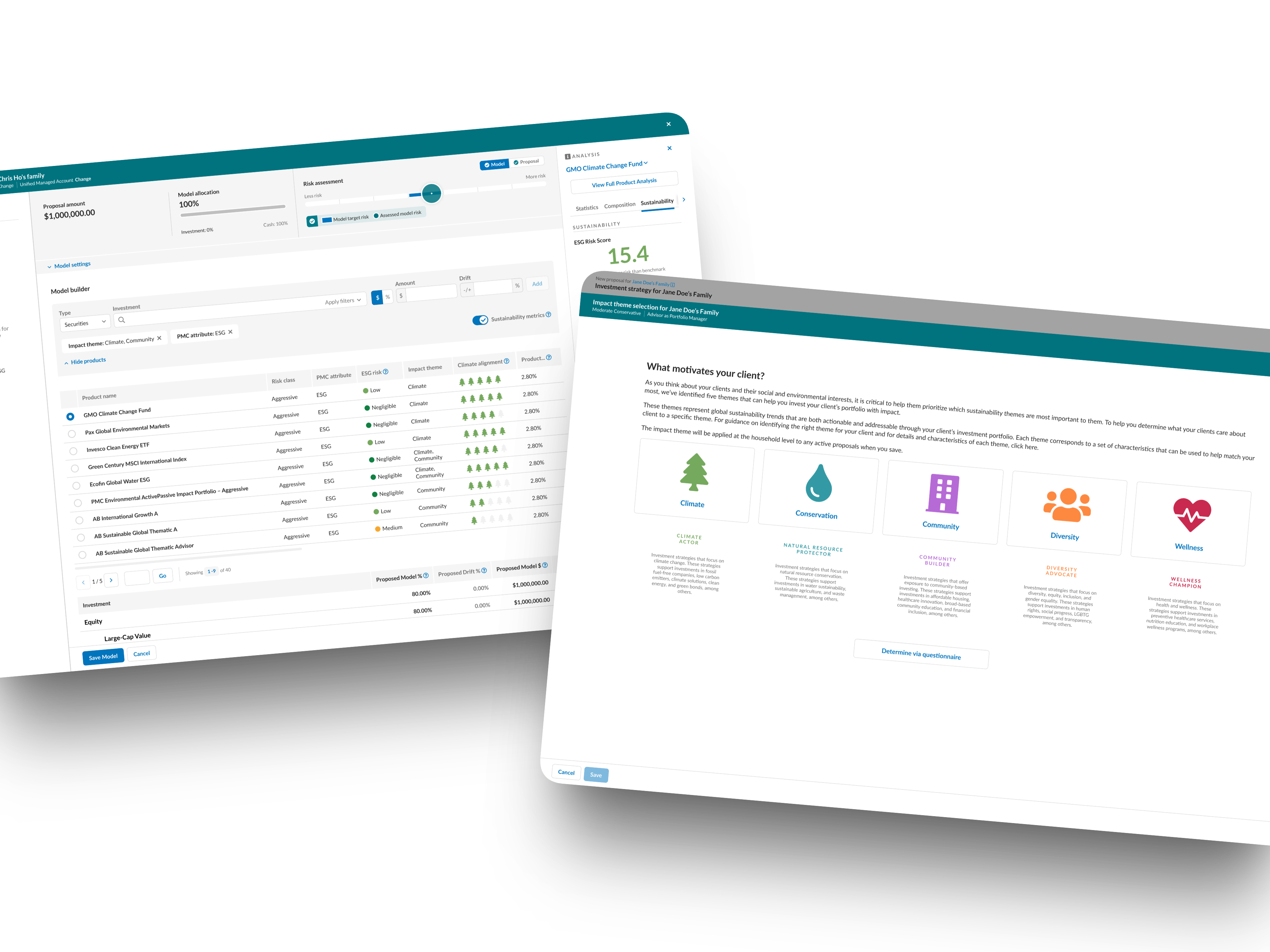
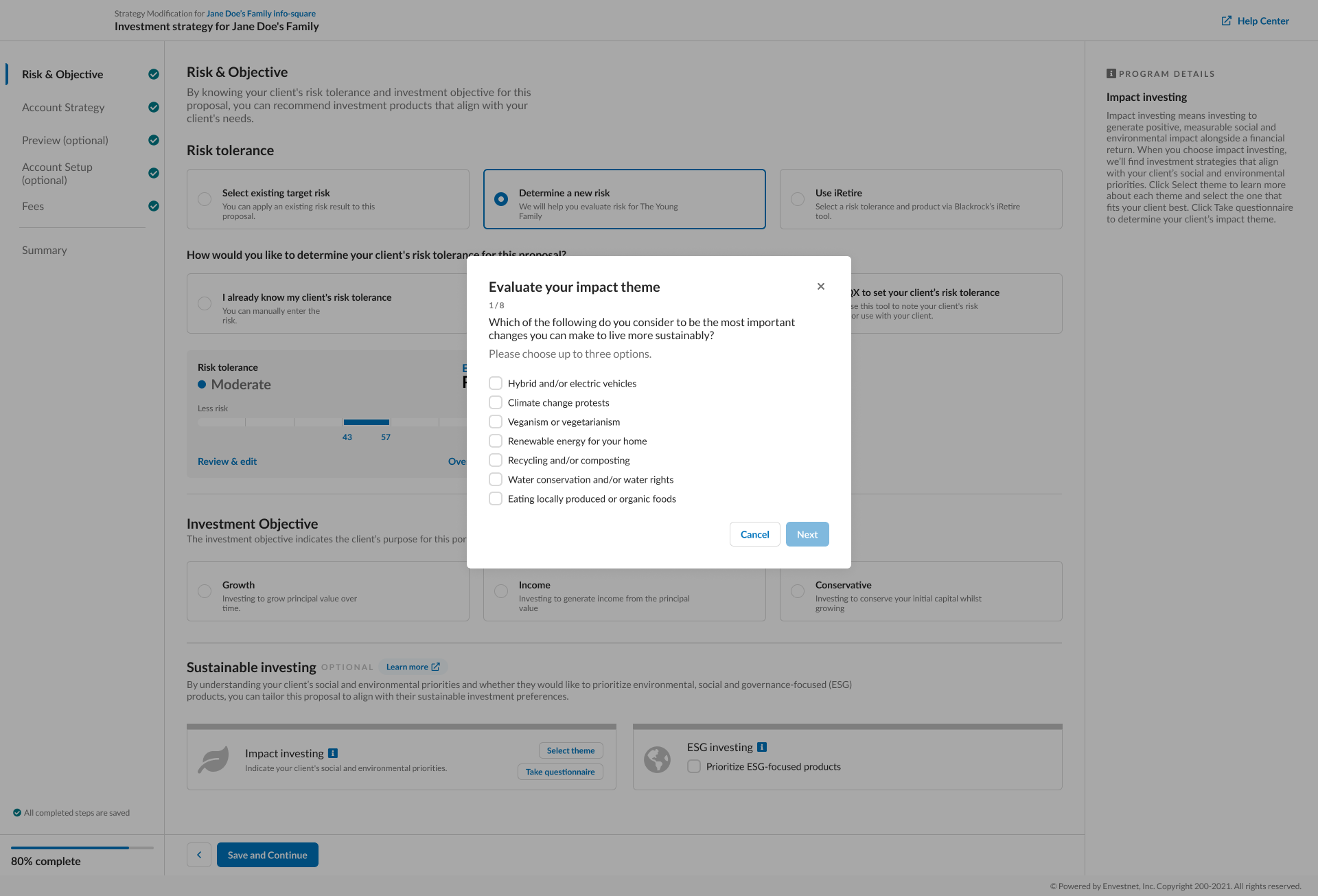
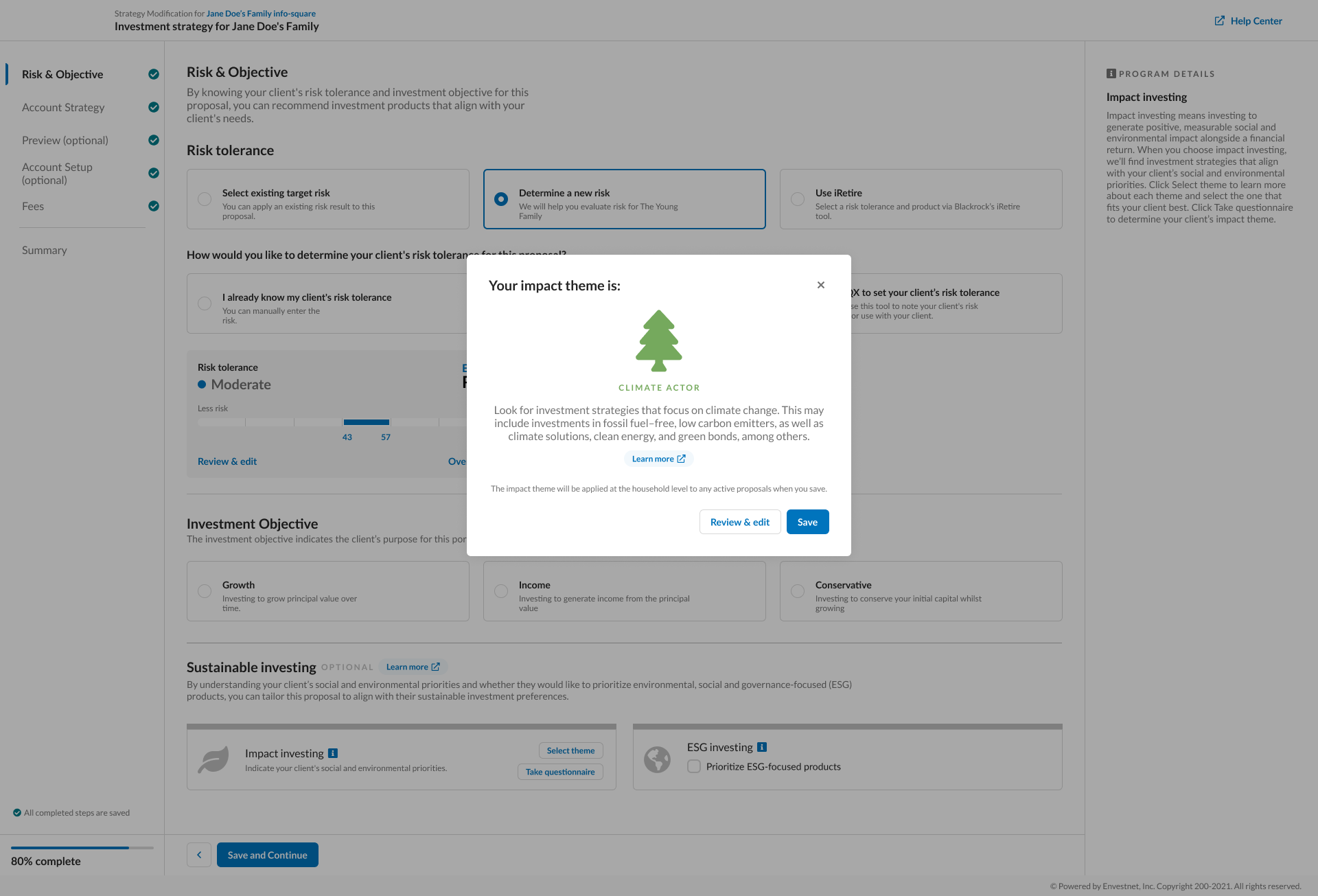
Before talking products, advisors needed a read on their client’s values. I designed a preferences assessment advisors could take on a client’s behalf, which mapped answers to an impact persona: climate, community, conservation, diversity, or wellness. The result gave the rest of the flow a clear point of view to build from, like a “Climate Actor” who wants fossil-fuel-free, low-carbon, and clean-energy strategies.
Surface sustainability where advisors already build.
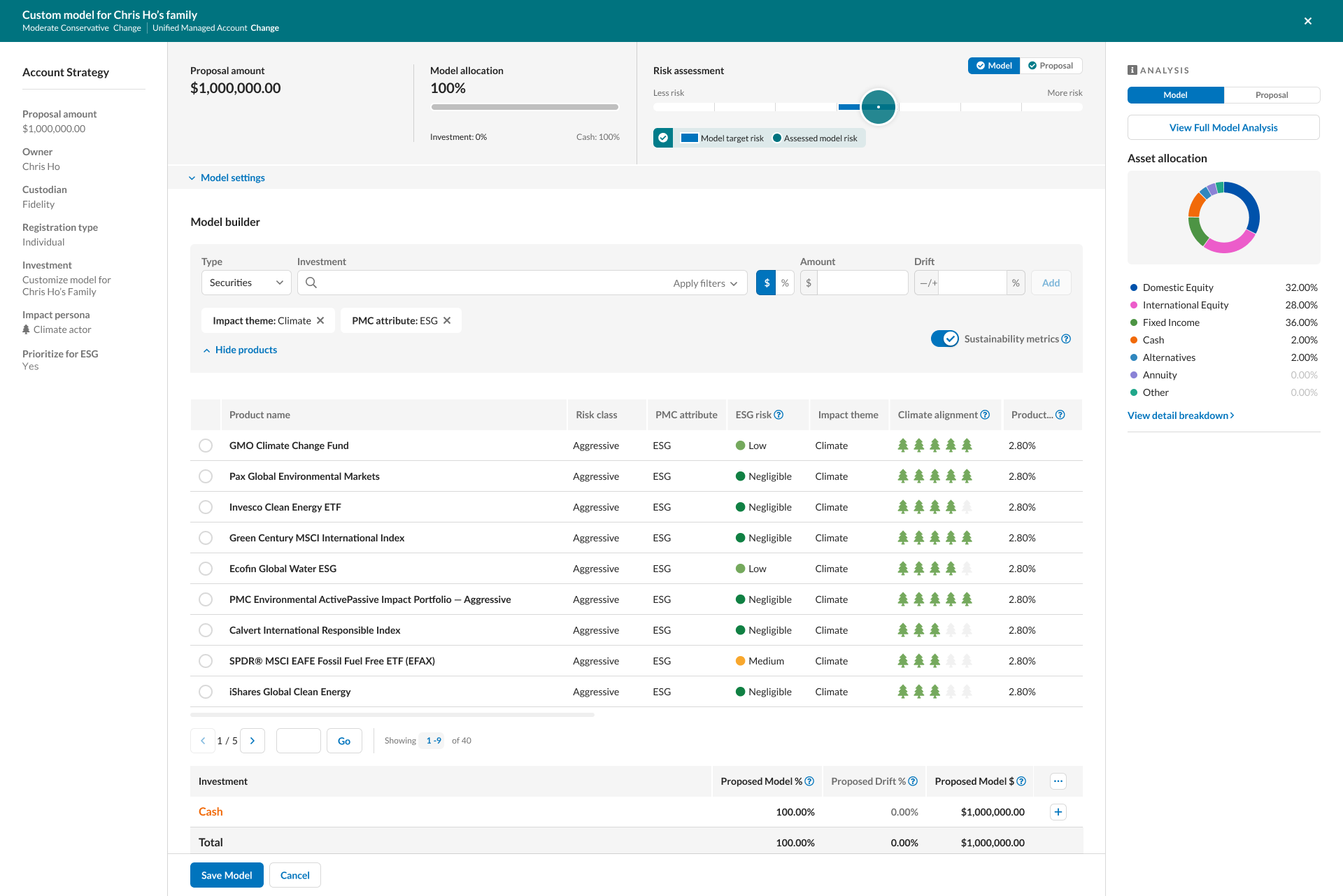
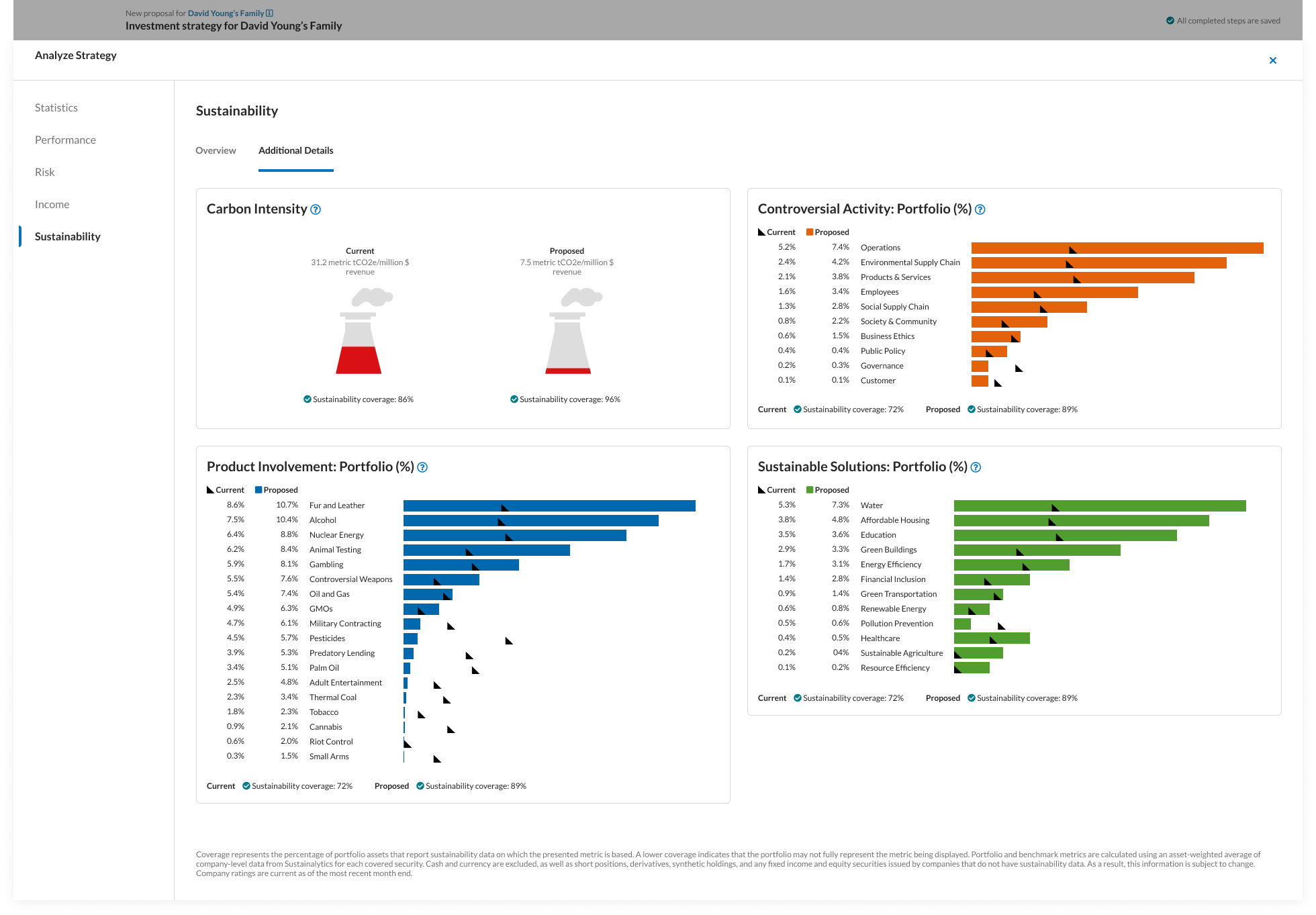
Model Builder is the tool advisors use in Next Gen Proposals to construct portfolios. Rather than bolt on a separate ESG experience, I added sustainability into the workflow that already existed. A single toggle layered in impact alignment, ESG risk score, carbon intensity, product involvement, controversial activity, and sustainable solutions, and advisors could filter the product universe by impact theme and PMC attribute right alongside risk and performance.
Make dense data presentable.
An ESG risk score measures a company’s exposure to long-term environmental, social, and governance risks, and the underlying data from Sustainalytics and Morningstar is dense. My job was to turn it into something an advisor could confidently put in front of a client. Every metric was framed as current versus proposed so the value of a change was obvious at a glance: a falling ESG risk score, climbing impact alignment, lower carbon intensity, less controversial activity, more exposure to sustainable solutions.
Outcomes
Sustainability, woven through the platform.
The work shipped across multiple advisor tools, from the preferences assessment to Model Builder to Client Reporting, integrating sustainability into the Client Portal, Proposals, and Configuration surfaces without overloading advisors with new complexity. Each addition rode on workflows they already knew.
The data-visualization direction was validated before launch through A/B testing with 144 participants and interviews with clients at major financial institutions, which is how a category that started as dense third-party data became something advisors could actually use in a client conversation.
Reflection
Comparison is the most persuasive design.
The single most effective decision was framing everything as current versus proposed. Advisors did not need to understand Sustainalytics methodology to feel the difference between a 30.2 ESG risk score and a 15.2. Showing the gap did the convincing.
This was also my first real lesson in designing for regulated, high-stakes financial products and in serving an internal client who behaves like an external one. Both lessons carried straight into the compliance work I did next at Twilio.